

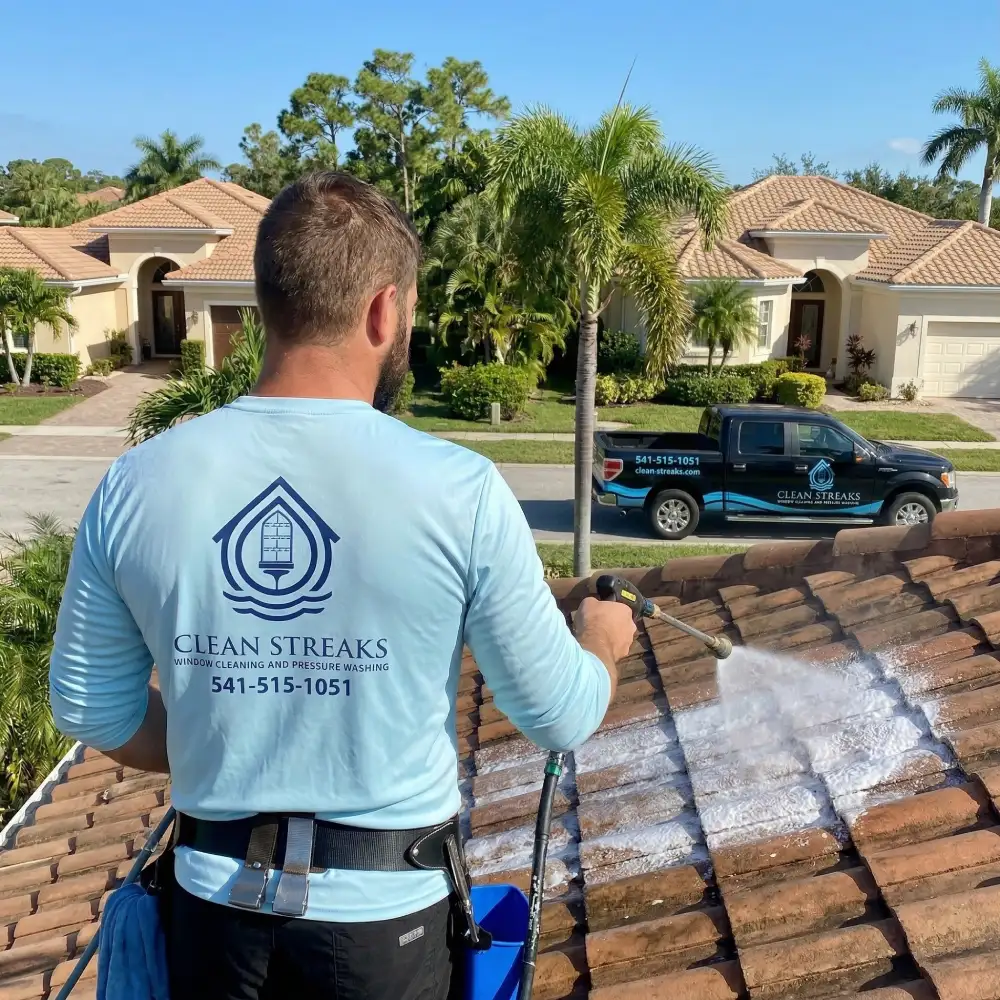
That dark streaking across your roof isn’t aging or weather staining. It’s algae, mold, and organic growth that has taken hold and will keep spreading until it gets treated. Bonita Springs and the rest of Southwest Florida give these organisms everything they need: year-round humidity, warmth, shade from overhanging trees, and moisture that rarely dries out between storms. Homes with branches pressing against the roof surface or a persistently shaded north side tend to see the fastest buildup, but no roof in this climate is immune.
Clean Streaks provides professional roof cleaning for Bonita Springs homeowners using a low-pressure, chemical-based process that kills organic growth at the source rather than just rinsing the surface. Applying sodium hypochlorite, letting it dwell, and rinsing at a controlled lower pressure removes what’s actually there. That’s the difference between a result that lasts and one where growth is back in a few weeks because nothing was treated. How long a roof holds a cleaning also depends on the property itself, and we explain that before the job starts so your expectations match your specific roof.

Roof cleaning is quoted as a custom estimate rather than a published square-foot rate. We need to see the roof, assess the staining, and factor in access before giving an accurate number. Jobs start at approximately $450–$500, and the final price depends on what we find. Factors that affect the total include:
Most jobs run 2 to 5 hours from setup to finish, and we build in enough buffer that the work doesn’t get rushed.





Asphalt shingles are one of the two roof materials we clean. We apply a generous coat of sodium hypochlorite (SH), let it dwell long enough for the chemistry to work, then rinse. The distinction with shingles is in the rinse step: because asphalt shingles have a granule surface embedded in the material, we keep the pressure gentler, the same way we’d approach vinyl siding. The SH handles the cleaning. The rinse clears what’s been treated.

Tile roofs often produce the most dramatic results. A barrel tile roof that has turned almost completely black when it should be terracotta red is exactly what this process was designed for. We apply sodium hypochlorite (SH), let it dwell, rinse at a controlled lower pressure, and reapply if heavier staining needs a second pass. The consistent rule with tile: we stay off the roof as much as possible because tile is fragile and breaks underfoot.

Some materials and conditions fall outside what we clean. Metal roofs are excluded because of liability concerns. Clay and slate are not part of our service. Beyond material type, we also decline jobs where the pitch is extreme or working height reaches unsafe levels, including very large homes where we’d be operating around 40 feet off the ground. We’d rather turn down a job than push past safe working limits.


Our process uses no surface cleaners, no turbo nozzles, and no hard PSI (pounds per square inch) tips at any point. The sodium hypochlorite does the actual cleaning by killing mold, algae, and organic buildup; the lower-pressure rinse removes what’s been treated rather than substituting for it. For fragile tile and granule-surface shingles, that distinction is meaningful.

Before any chemical goes on, we inspect for loose shingles, shifted flashing, and broken or displaced tiles. Anything we find gets photographed and shown to the homeowner before work continues. That creates a clear record of pre-existing conditions so there’s no ambiguity afterward.

On smaller homes where the gutter line is reachable from a ladder, the full job gets done without stepping onto the surface. On larger or more complex roofs with upper sections or turrets, we access only what the work specifically requires. Every step on the surface is deliberate.

Before treating any section, we flood the plants on that side with water and keep rinsing while we work. We bag downspouts where runoff volume warrants it, and apply an SH neutralizer across treated areas and surrounding plant life after the job is done.

If the roof pitch is extreme, the working height puts our crew in an unsafe position, or the material falls outside the types we service, we say so before anyone shows up with equipment. A very steep roof on a large home where we’d be 40 feet up is not a job we’ll take on, and we’d rather be direct about that upfront than commit to work we can’t do responsibly.

We regularly hear the same comment from first-time clients: they’re surprised someone answered. We return calls, respond to texts, and show up on time. After an in-person estimate, the quote goes to your email and by text. We follow up the next day, again around three days later, and once more after a week or two if the job is still open. We schedule around your availability, including Saturdays.

If a section wasn’t fully treated or a spot was missed, we come back and address it. Depending on what we find, that means re-spraying the area, running a second treatment pass, or spot-cleaning with a small pump sprayer. If something was missed, we address it promptly and without hassle.


We evaluate roof size, material, growth severity, pitch, and access before anything else. If the roof falls outside what we can safely service, we say so here.
Before any chemical touches the roof, we check for broken tile, lifted shingles, and shifted flashing. Everything we find gets photographed and shown to the homeowner before work starts.
Smaller homes are usually handled entirely from a ladder. Larger roofs may require limited surface access to reach upper sections, turrets, and second-story areas. We bag downspouts where needed and pre-wet plants before treating each section.
The roof gets an even coat of sodium hypochlorite, then we wait. The dwell time is where the actual cleaning happens: the SH kills mold, algae, and organic growth down to the root level so it doesn’t return in a few weeks the way it would after a rinse-only approach. Once it has worked, we rinse at lower pressure suited to the material. Asphalt shingles get a gentler pass to protect the granule surface, handled the same way we’d treat vinyl siding. After the job, we apply an SH neutralizer across treated areas and landscaping.
If heavier staining needs a second pass, we reapply. Small missed sections get addressed with a pump sprayer. Before leaving, we walk through what to expect. Roofs with good sun and trimmed trees can hold a cleaning for over a year, with some properties staying clean for around 1.5 to 2 years. Roofs with overhanging branches or heavy shade will foul faster, and some Bonita Springs homes are on an annual maintenance cycle.
Proper roof cleaning can produce results that last well over a year in favorable conditions, with some properties staying clean for around 1.5 to 2 years. That durability comes from treating growth at the root rather than rinsing the surface. Real-world results vary based on conditions specific to your property, including:
What we stand behind regardless of conditions is our follow-through. If growth returns unusually fast, if something was missed, or if a section needs a second look, we come back and handle it. We also reach out around the one-year mark to check in, because for some homes in this climate, annual service is simply part of the routine.


We clean asphalt shingle roofs and tile roofs, including flat tile and barrel tile. We do not clean metal roofs, and clay and slate are not part of our roof-cleaning service. We may also decline roofs that are too steep, too high, or outside safe access limits.
Roof cleaning starts at about $450 to $500, but final pricing depends on the size of the roof, how dirty it is, and how easy it is to access. Heavier staining, larger roofs, and more difficult working conditions can increase the cost. We quote roof cleaning as a custom estimate rather than a strict square-foot formula.
Most roof-cleaning jobs take about 2 to 5 hours. The exact timeline depends on roof size, staining severity, access, and whether the roof needs additional treatment or touch-up work.
We use a low-pressure soft-wash style roof-cleaning process. We inspect the roof first, document visible pre-existing issues, manage runoff, apply SH treatment, let it dwell, and then rinse with lower pressure based on the roof type. If needed, we reapply treatment and touch up missed areas instead of switching to aggressive pressure.
Our process is designed to avoid the risks associated with aggressive pressure washing. We do not use high pressure on the roof, surface cleaners, turbo nozzles, or hard PSI tips. We also minimize roof walking whenever possible and adjust the rinse method for fragile tile and asphalt shingles.
It depends on the home and the roof layout. Smaller homes may be worked from the top of a ladder, while larger or more complex roofs may require limited roof access to reach all areas properly. We try to stay off the roof as much as possible, especially on fragile tiles.
We protect landscaping by flooding plants with water before treatment, rinsing them while we work, controlling runoff, and applying an SH neutralizer afterward. In some cases, we also bag downspouts so runoff does not flow directly into the yard. Plant protection is built into the workflow, not treated as an afterthought.
We inspect for visible issues like broken tile, loose shingles, and flashing concerns before work begins. If we find anything noticeable, we document it and show it to the homeowner before moving forward. This helps prevent confusion about what was already there before cleaning.
If we miss an area or a homeowner is unhappy with part of the result, we assess the issue and come back to correct it when appropriate. That can include re-spraying, re-cleaning, or spot-cleaning a missed section with a small pump sprayer.
Roof-cleaning results can last well over a year in the right conditions, and some roofs may stay clean for around 1.5 to 2 years. However, roofs with overhanging trees, repeated shade, tree contact, or more moisture can get dirty faster. In Southwest Florida, some homes may benefit from yearly roof-cleaning service or touch-ups.
Bonita Springs roofs deal with humidity, moisture, shade, and organic growth that can speed up staining and regrowth. Roofs with trees touching them or less sun exposure often foul faster than roofs in more open conditions. This is why maintenance timing can vary from one property to another.
If your roof is covered in dark streaks, algae staining, or barrel tile that has lost its original color, we’re ready to help. We serve homeowners in Bonita Springs, FL with safe, low-pressure roof cleaning built around chemical treatment, careful pre-inspection, minimal roof traffic, and full landscaping protection from start to finish. Call us at 541-515-1051 or request an estimate through our contact form and we’ll schedule an in-person visit to see exactly what we’re working with.


